Checking hours...
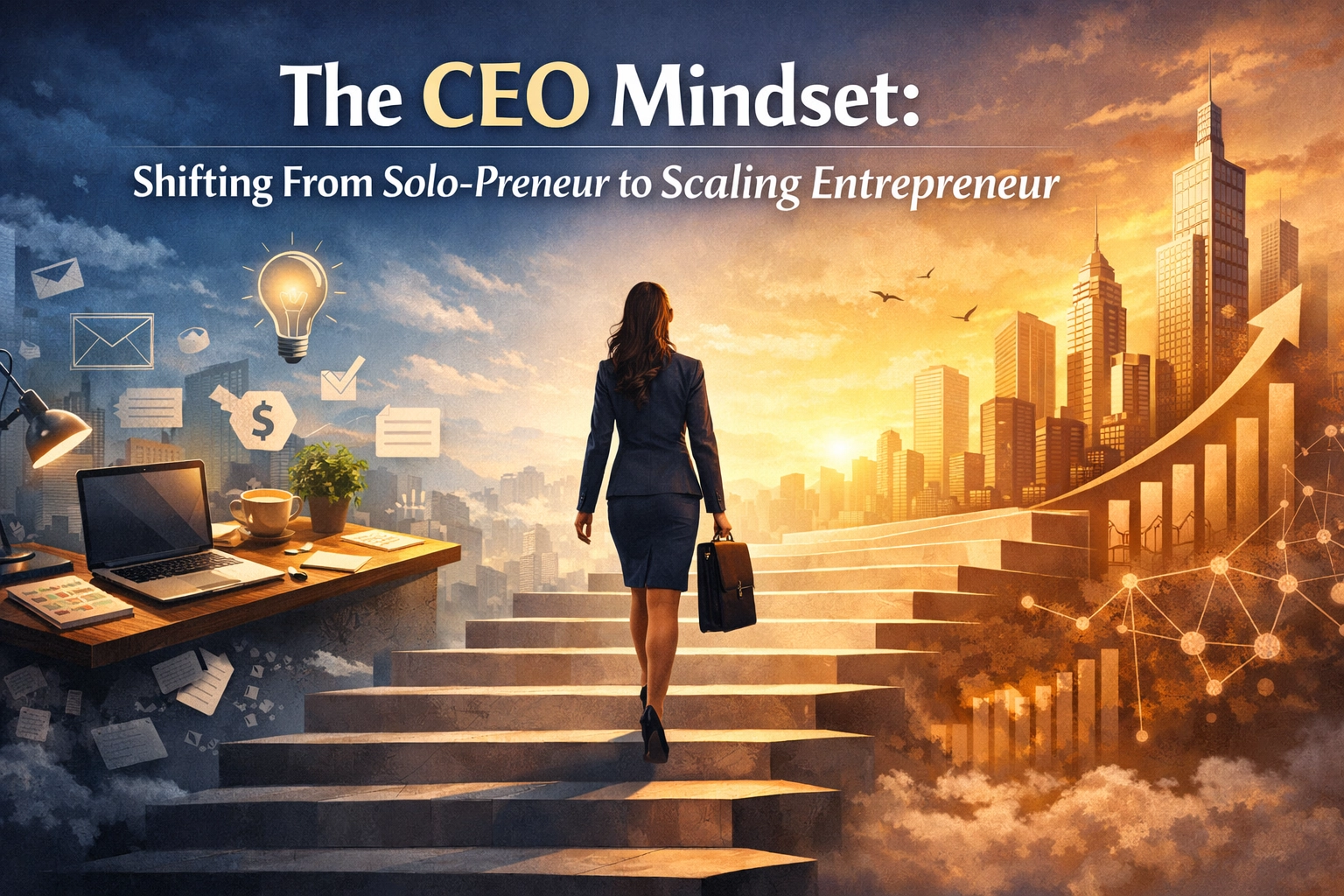
The "solo-preneur" is a romanticized myth that kills real growth. Discover how to build a machine that works harder than you ever could.
The "solo-preneur" is a romanticized myth that kills real growth. We've been conditioned to believe that the ultimate entrepreneur is a jack-of-all-trades, a lone wolf burning the midnight oil to manage every invoice, every client call, and every line of code. In reality, that isn't a business: it's a high-stakes job with a boss who never lets you take a vacation.
If your business depends entirely on your physical presence and daily labor, you haven't built an enterprise; you've built a cage. To scale, you must dismantle the "hustle" mentality. Growth is not about working harder; it is about building a machine that works harder than you ever could.
At Starr Enterprise, we don't just advise on business; we architect structures that outlive the founder's daily input. The transition from a solo operator to a scaling CEO requires a radical, often painful, psychological shift. You must move from being the engine of the business to becoming its lead engineer.
The fundamental flaw in the solo-preneur mindset is the obsession with execution over design. When you are a solo operator, your value is tied to your output. When you are a CEO, your value is tied to your vision and the systems you put in place to execute that vision.
Architects do not lay bricks. They design the blueprint, ensure the foundation is poured correctly, and manage the specialists who execute the build. If the architect starts laying bricks, the project loses its oversight. Deadlines slip. The structural integrity is compromised. Most importantly, the architect stops looking at the horizon and starts looking at the ground.

To make this shift, you must adopt the "Expert-Architect" persona. This means your primary tool is no longer a shovel; it's a compass. You are no longer responsible for doing the work: you are responsible for ensuring the work gets done according to a specific, high-standard protocol.
"If your business cannot survive 30 days without your direct intervention, you don't own a company. You own a liability."
This is the difference between a freelance consultant and a business consulting powerhouse. One sells hours; the other sells infrastructure.
In the old way of doing business, processes were often stored in the founder's head. This is "tribal knowledge," and it is the enemy of scale. When you scale, you must externalize your expertise. You need to build a "machine" where inputs lead to predictable outputs, regardless of who is pulling the lever.
Think of your business as a series of mechanical assemblies. You have the lead generation assembly, the sales conversion assembly, and the fulfillment assembly. Each must have a documented blueprint. At Starr Enterprise, we emphasize streamlined startup formation because the foundation must be rigid enough to support weight, but the systems must be fluid enough to evolve.

Building these systems requires an urgent, high-momentum approach. Do not spend six months "perfecting" an internal manual. Use the 48-hour protocol: identify a bottleneck, document the current best-practice solution within two days, and delegate it. Speed is your greatest asset. Analysis paralysis is a luxury you cannot afford when the market is moving at 2026 speeds.
The hardest part of shifting to a CEO mindset is the "surgery of separation." This is the process of extracting yourself from the daily operations of your brand. Many founders suffer from a god complex: the belief that "nobody can do it as well as I can."
While that might be true in the short term, it is a scaling death sentence. A CEO's job is to find people who are 80% as good as they are, give them the tools to become 100% as good, and then get out of their way. This requires a level of trust that most solo-preneurs find terrifying.

However, delegation is not "abdication." You are not throwing tasks over a wall and hoping for the best. You are installing a team and holding them accountable to the machine's metrics. This is why financial clarity is non-negotiable. You cannot delegate what you cannot measure. Utilizing professional financial services allows you to see the numbers clearly, transforming "gut feelings" into hard data that drives your team's performance.
The solo-preneur is a firefighter. They wake up and wait for the first blaze: a late payment, a disgruntled client, a technical glitch. They spend their energy reacting to the world.
The scaling CEO is a weather forecaster and a city planner. They are looking three to five years into the future. While the rest of the team is focused on the next quarter, the CEO is wondering how the industry will shift by 2030. They are looking at the death of traditional business plans and anticipating the next radical shift in market dynamics.
To move from reactive to proactive, you must protect your time ruthlessly. The CEO mindset requires "Deep Work" blocks where the phone is off, and the focus is entirely on high-impact strategic growth. If you are still answering basic customer service emails, you are stealing time from your company's future.
If you are ready to stop being a solo-preneur and start being a CEO, you don't need a three-month transition plan. You need an immediate structural overhaul. We advocate for a radical, 48-hour shift:
For the next 48 hours, track every single task you perform. Mark anything that doesn't directly contribute to long-term strategy or high-level sales.
Pick the most time-consuming task. Write down the "blueprint" for how it is done. This is your first SOP (Standard Operating Procedure).
By the end of the 48 hours, that task must no longer be on your plate. Whether you hire a virtual assistant, use an automated tool, or delegate it to an existing team member, you must cut the cord.
Look at your legal and financial structure. Is it built for one person or for ten? If you haven't reviewed your service agreements or corporate filings lately, you are likely operating on a foundation of sand.

As you scale, your primary product eventually stops being the service you provide and starts being the culture you build. Culture is the invisible infrastructure. It's what happens when you aren't in the room.
A solo-preneur controls through presence; a CEO controls through values. You must build a high-performance culture where innovation is expected and mistakes are treated as data points for system optimization. This is the path followed by leaders like Mike Brown, who understood early on that Starr Enterprise wasn't just about consulting: it was about creating a legacy of excellence.
Your team should feel like they are part of an elite unit, not just employees. They need to understand the "why" behind the blueprints. When they own the vision, they will maintain the machine with the same intensity that you do.
The transition from solo-preneur to scaling entrepreneur is not a slow evolution; it is a conscious, disciplined choice. It is the decision to stop being the most important person in the room so that the business can become the most important entity in the market.
It's time to stop "hustling" and start building. The world doesn't need more busy people; it needs more effective leaders who can build structures that solve real problems at scale. If you are ready to stop laying bricks and start designing the skyline, it's time to rethink your entire approach to business architecture.
Your future self: the one running a lean, mean, profitable machine: is waiting for you to let go of the shovel.